
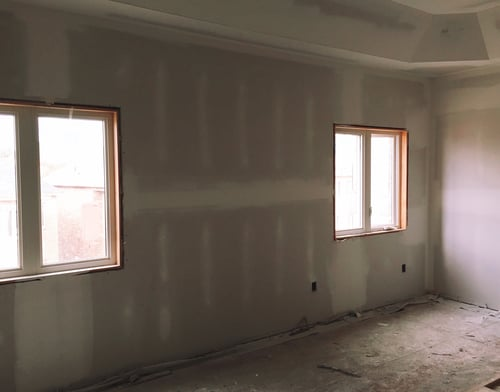
Walk into most new houses and you're looking at taped drywall: paper-faced board with joint compound over the seams and screws, sanded smooth and painted. Walk into a house finished in veneer plaster and the walls feel different. They're harder, they sound more solid when you knock, and they hold up to furniture and kids far better. Both systems start with board on the studs. The difference is what goes on top.
With taped drywall, only the seams and fasteners get compound. That means the wall is two different surfaces, paper and mud, and under raking light from a window you can sometimes see the difference. It also means sanding, and sanding means dust through the whole house.
Veneer plaster covers the entire wall. We hang blueboard, a gypsum board with a special face that bonds with plaster, tape the joints, and trowel on one or two thin coats of real plaster. It sets chemically within hours, is far harder than joint compound, and needs almost no sanding. In many cases the walls are ready for primer the next day.
So which should you choose? For closets, garages, and budget-driven rental work, taped drywall is perfectly good. For main living spaces, high-traffic hallways, stairwells, and vaulted ceilings where light shows every flaw, veneer plaster is worth it. It's also the natural choice when you're matching the original plaster in an older home.
The cost difference is usually smaller than people expect, especially once you count the days of sanding that plaster avoids. Ask for both prices on your estimate and decide room by room. That's how we quote it.